Pomeranian Myths: Mini, Extra Mini, Teacup and Boo Pomeranians
Mini Pomeranian, extra mini Pomeranian, teacup Pomeranian, Boo Pomeranian, teddy bear Pomeranian – online classifieds and pet websites showcase a dizzying variety of enticing labels. But are these genuinely distinct Pomeranian types?
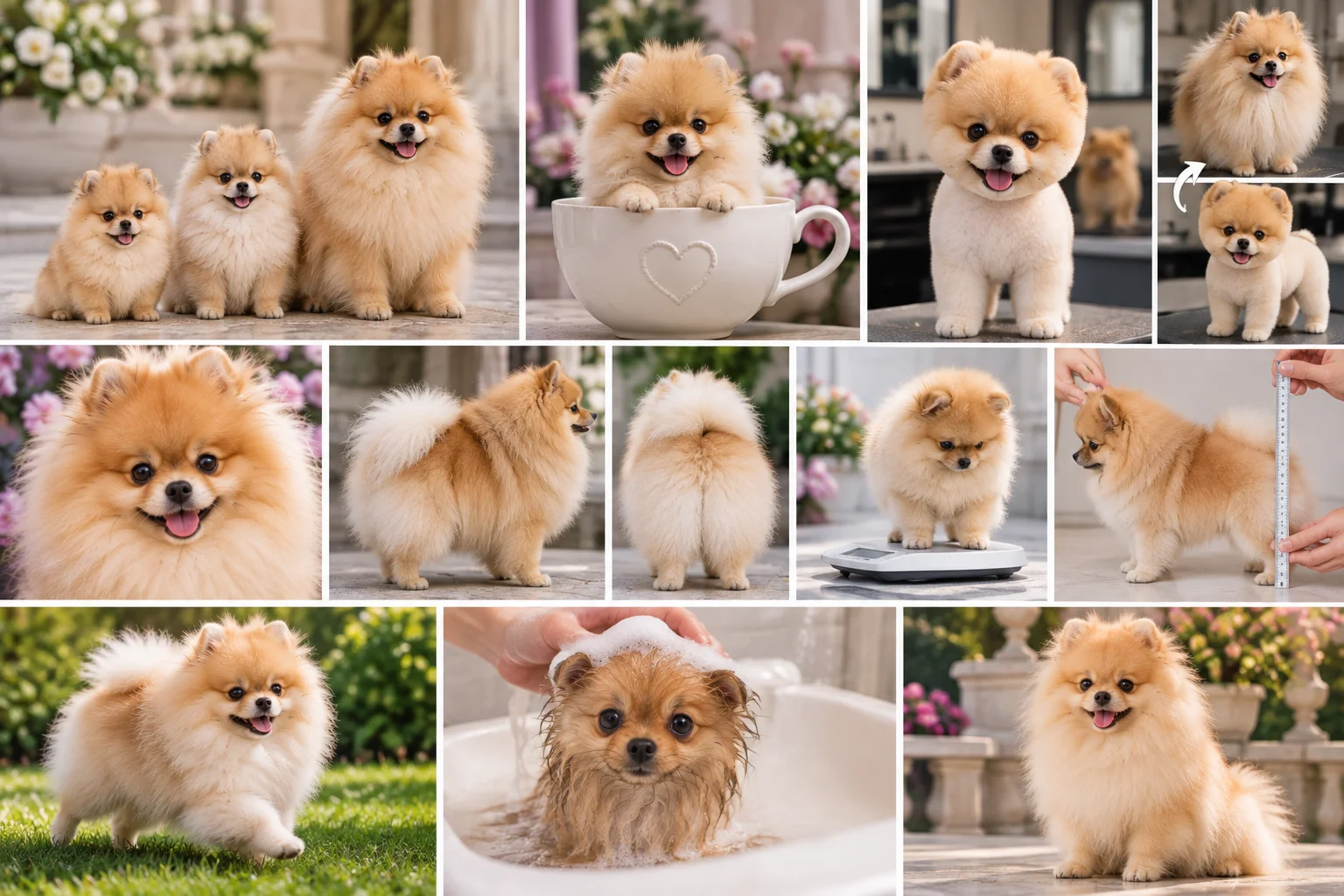
The concise answer is: No. The Pomeranian, known internationally as the Zwergspitz or Dwarf Spitz, represents a single well-defined breed variety. Terms like "mini", "extra mini", "teacup", or "Boo" do not denote separate, officially recognized breeds or official FCI size classifications. Let us examine the most widespread myths and commercial misconceptions.
Do Mini or Extra Mini Pomeranians Exist?
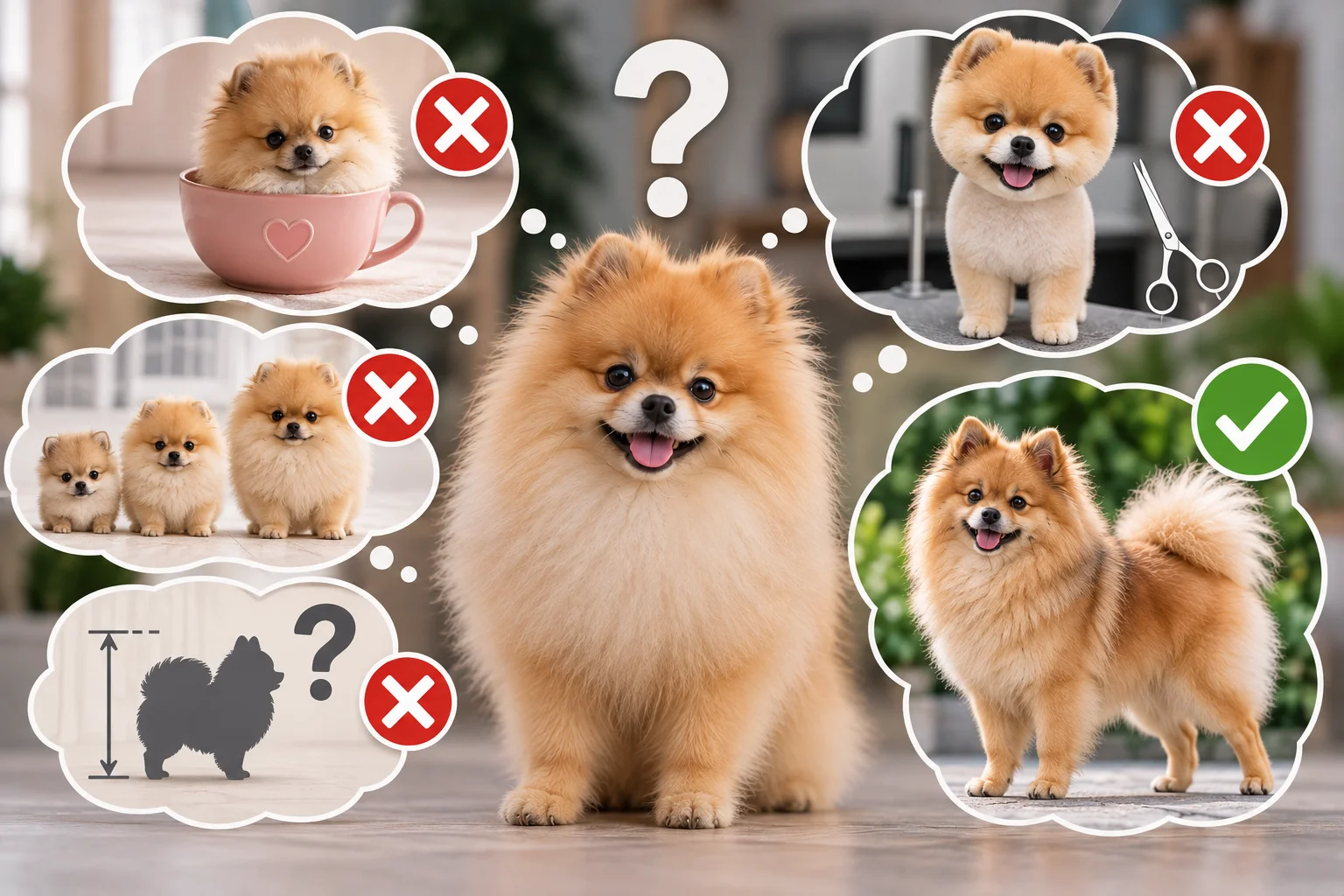
Officially, there is no separate mini or extra mini Pomeranian breed variety.
The Pomeranian is already the smallest recognized size classification within the German Spitz family. The international FCI standard establishes the ideal withers height for a Pomeranian/Zwergspitz at 21 cm ± 3 cm (an allowable range of 18 to 24 cm).
Naturally, individual puppies exhibit slight morphological variations. Within a single pedigree litter, one puppy may grow slightly more compact while a sibling turns out slightly larger.
Commercial sellers frequently market naturally smaller puppies with catchy prefixes like "mini" or "extra mini" to command inflated price premiums. The label "mini" does not represent a novel or superior breed classification.
What is a Teacup Pomeranian?
A "teacup Pomeranian" is neither an official breed designation nor an approved kennel club standard.
The term "teacup" originated predominantly across North American commercial pet trade platforms as an advertising gimmick to market exceptionally delicate or premature puppies.
No international kennel registry recognizes:
mini Pomeranian, extra mini Pomeranian, micro Pomeranian, or teacup Pomeranian.
These are informal commercial phrases intended strictly for marketing appeal.
Furthermore, extreme miniaturization does not correlate with quality. Responsible preservation breeding prioritizes anatomical balance, sturdy bone density, fluid gait, confident temperament, and comprehensive health testing above mere diminutive size.
What is the Weight of an Adult Pomeranian?
A Pomeranian's size should never be evaluated solely by a single kilogram measurement on a kitchen scale.
An adult dog's weight depends upon height at withers, bone density, muscular condition, gender, and overall conformation. A puppy's quality cannot be judged merely by predicting whether it will weigh 1.8 kg or 2.5 kg.
Smaller is not automatically better: A healthy, structurally sound Pomeranian with solid bones and vibrant energy is vastly superior to an unnaturally fragile "extra mini" individual bred solely for size reduction.
Can You Accurately Predict a Puppy's Adult Size?
With mathematical certainty: no.
An experienced, ethical preservation breeder can provide reliable estimations based upon developmental curves, bone thickness, paw size, and ancestral pedigree lines. However, promising an exact adult weight down to the gram for an 8-week-old puppy is professionally unrealistic.
Prospective puppy buyers should exercise caution when encountering sellers who guarantee extreme miniature sizes for very young litters.
What is a Boo Pomeranian?
A "Boo Pomeranian" is not a separate dog breed.
The name originated from "Boo", an adorable American Pomeranian who became a worldwide social media celebrity due to his distinct, spherical, short teddy-bear haircut style.
Consequently, millions of prospective dog owners began asking breeders for a "Boo puppy".
In reality, Boo himself was simply a purebred Pomeranian. His iconic round appearance was entirely the result of specialized, tailored coat sculpting.
Is a Teddy Bear Pomeranian a Separate Type?
The "teddy bear Pomeranian" or "bear-faced Pomeranian" is another informal descriptive phrase, not an official breed standard.
Groomers and pet owners use this phrase to characterize Pomeranians with slightly shorter, broader muzzles, expressive dark eyes, and dense cheek ruffs that evoke the charming aura of a stuffed plush toy.
While subtle facial variations exist between bloodlines, the "teddy bear" look is not an independent kennel club variety.
Is the Boo Cut Simply a Grooming Style?
The classic Boo hairstyle became famous through sculpting the coat into a rounded, compact silhouette.
However, the Pomeranian is an ancient double-coated breed: its soft, dense undercoat and harsher topcoat work symbiotically to insulate against cold, deflect heat, and protect sensitive skin from ultraviolet radiation.
There is a critical difference between gentle, scissored shaping by a master groomer and shaving a dog's coat down with electric clippers.
The Magic Little Foot Philosophy: We release our pedigree puppies with their natural, healthy, profuse double coats intact, ensuring optimal long-term skin health.
Is Shaving a Pomeranian's Double Coat Dangerous?
Yes. Shaving a Pomeranian's double coat close to the skin with electric clippers is strongly discouraged by veterinarians and dermatologists.
Close shaving can severely disrupt hair follicles, resulting in post-clipping alopecia: hair may regrow sparsely, patchily, with altered woolly texture, or fail to grow back altogether for years.
Families who desire a rounded, tidy aesthetic should seek certified groomers skilled in scissors-only trimming tailored specifically to Spitz double coats.
What Defines a Genuine, Purebred Pomeranian?
Authentic Pomeranian excellence is not determined by whimsical tags like "mini", "teacup", or "teddy bear".
The true defining hallmarks of quality:
- Documented Pedigree: Official FCI export pedigree certificates and verifiable ancestral bloodlines.
- Breed Type & Conformation: Compact square proportions, level topline, proud arch of neck, and high tail carriage.
- Physical Health: Sound patella scores, clear cardiac screening, and robust vitality.
- Temperament: Intelligent, buoyant, spirited, and affectionate character.
The ultimate objective of elite breeding is not to manufacture the smallest possible dog at all costs. The true goal is a vibrant, harmoniously proportioned, healthy companion built to live a long, joyful life.
Common Questions About Mini, Teacup, and Boo Pomeranians
Essential insights for discerning puppy buyers and dog lovers:
Does a mini Pomeranian actually exist?
Officially, no separate mini Pomeranian breed or FCI size tier exists. The Pomeranian (Zwergspitz) is already the smallest size variety of the German Spitz family. The term 'mini' is merely colloquial marketing.
Is there an extra mini Pomeranian?
No. 'Extra mini' is strictly a commercial marketing label used by unauthorized vendors to advertise naturally petite individuals within a normal pedigree litter.
What is a teacup Pomeranian?
A teacup Pomeranian is not a recognized breed or standard. The term originates in North American pet trade advertising to describe exceptionally small puppies. Extreme miniaturization frequently compromises skeletal robustness.
Does a micro Pomeranian exist?
No. Micro, mini, extra mini, and teacup are entirely unscientific marketing buzzwords not recognized by the FCI or international kennel clubs.
What is a Boo Pomeranian?
A Boo Pomeranian is not a distinct breed. The term became viral following the famous internet pet 'Boo', whose teddy-bear grooming haircut gained worldwide celebrity status. Boo himself was a purebred Pomeranian.
Is a Pomeranian Boo the same as a Zwergspitz?
Yes. 'Pomeranian Boo' is merely a reference to a haircut style. Underneath the sculpted coat, the dog is an authentic Pomeranian / Zwergspitz.
Is a teddy bear Pomeranian a distinct breed variety?
No. 'Teddy bear' refers casually to Pomeranians with slightly compact facial muzzles and full, profuse cheek furnishings that create an adorable bear-like silhouette.
Can you guarantee an 8-week-old puppy's exact adult weight?
No honest breeder can guarantee an exact gram weight months in advance. Experienced breeders provide informed estimates based on bone density and lineage, but natural developmental variables always apply.
Can you shave a Pomeranian's coat short?
You should never shave or buzz a Pomeranian's coat with electric clippers. Shaving destroys the natural double coat, which protects against thermal extremes and sun damage.
Does a Pomeranian's coat grow back properly after shaving?
Often it does not regrow properly. Severe clipper trimming frequently causes post-clipping alopecia, patchy regrowth, or a permanently damaged, woolly texture. Scissors-only styling is strongly advised.
